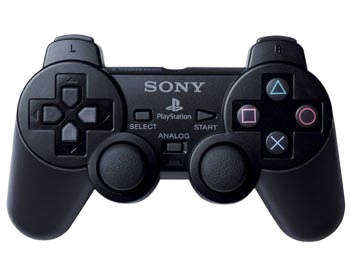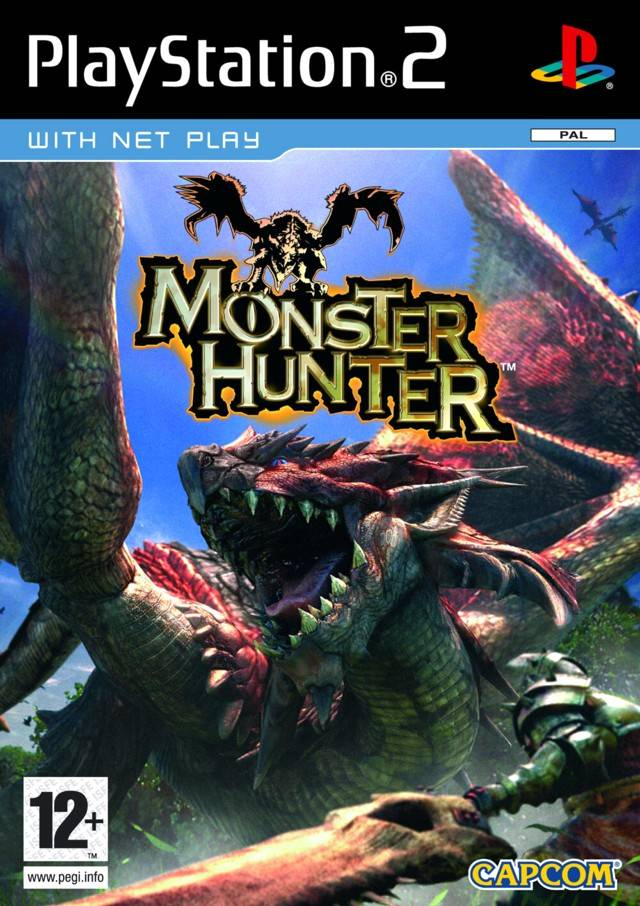
Okay, looking at that title, you might be wondering what "a game of shared bones" even means. As the first game in what would become a mighty franchise, Monster Hunter experiments with a lot of things, including attack moves being bound to the right analogue stick. It has a number of the titular monsters to hunt, and because it's the first experimental title on the PS2, that means huntable monsters share skeletons: if you fight and beat Yian Kut-Ku, you know how to fight and beat Gypceros, and you know how to fight and beat Rathalos. These enemies are given different properties, such as increasing amounts of health and damage, and might have special differential flourishes for some attacks, but the bones are the same: the rigging, the animations, the mechanics, and the enormous hitboxes that will somehow smack your hunter when their snout or tail is nowhere near you on screen. If you've worked out a weapon and a strategy that works for any of these creatures in the game, you can successfully transfer that method with little to no changes to the others.
You could argue that this should be most obvious with the "prey" line of Velociprey, Genprey, and Ioprey, and it is fairly obvious. However, because the above mentioned group of Yian Kut-Ku, Gypceros, and Rathalos are built up and operate as immensely powerful and intimidating targets who will dominate and make up the entire focus of your hunt, there's something that makes their shared bones even more obvious. For all that their designs are better distinguished from each other than the prey line, you will see Rathalos do the same blind-charge-into-your-hunter-that-leaves-the-monster-face-down-in-the-dirt that you've seen Yian Kut-Ku and Gypceros do, and I find that to be more striking for creatures designed to appear and be so different.
This is not to downplay how absolutely incredible the game is or the amount of effort clearly poured into it. Each of the above-mentioned winged terrors gets a map of their own to terrorise, with each map being distinct not only in theming but in layout, quests, and the variety of monsters within. The modelling, sound-designs, animations, and soundtrack are incredible.
Most retrospective looks at the first Monster Hunter label it clunky and call the resulting franchise a miracle. While it has its rough edges, including the already discussed attack hitboxes and the heavy reliance on shared bones, it spawning a series still going strong today doesn't surprise me. The other PS2 Monster Hunter, Monster Hunter Dos, expands on many of the concepts, shares just as many of the bones if not more, and is notoriously punishing and clunky. The franchise didn't die with these two entries due to sheer luck, but because the world presented in the very first game and the mechanics it contains are incredible. The shared bones are out of necessity due to development time and the limited amount of memory, but they also lead to a rewarding game cycle. If you know how to beat Yian Kut-Ku, you know how to beat Rathalos, which is extremely thrilling to pull off for the first time- and you might get lucky and discover the added mechanic where you can chop off and separately carve from Rathalos's tail, which is also excellent.
Full disclosure: I strongly believe the game is best played with the modern convenience of save-states, which is entirely how I got as far in the game as I did. There are egg-quests where I got lucky my first time, but plenty more where I retried the same split-seconds of panic again and again and again until saving in a moment of relative safety and inching progress along attempt by attempt. There are also many monsters in the game I have not hunted- you might look at my example line of wyverns and wonder where the hell Rathian is. I assume Rathian has the same bones, but I can't confirm this from personal experience: I played through the four-star level quests, completed the Rathalos five-star quest, obtained the sword of legend at the back of the village, and considered it a game well played. There are two levels of quests at the village I have not done, and am content not doing for now, as further progress seemed more and more locked behind further weapon and armor ingredient grinding at already completed quests, which I have had my fill of. My in game save file lists my time at over 18 hours, which does not capture the many hours spent loading save-states again and again.
I also did not play any of the town quests or hunt the monsters exclusive to that area. This is the online-only section of the game, an element which remains a strong part of the franchise's identity to this day, and my reasons for not playing it had nothing to do with the original servers being shut down. There are fan servers up and running for those who want to experience the town-exclusive hunts of Monster Hunter. I have simply never enjoyed multiplayer games or multiplayer elements, and have always played Monster Hunter titles as single-player affairs.
I might come back and finish the village quests one day, come back to the gauntlet of grinding and Getting Good I had my fill of the first time around. I might dip my toes into what the modern multiplayer Monster Hunter 1 experience is like. For now, having worked my way up to Rathalos slaughter and being worthy of the legendary sword is enough for me.
Monster Hunter for the PS2 is an incredible game with an immense amount of depth and charm for a first experimental venture, and one I recommend playing only with the luxury of save-states and the mental grace to not sweat completing it in full. There's a lot to enjoy, and there are more expansive and better constructed Monster Hunter games that follow.